Superman Comic Books
Superman: Special Reports
Imaginary Stories
Author: Sean Hogan (shogan@buckho.com)Last updated: September 27, 2004
Since, somewhere in Hypertime, everything we have ever read in a DC comic is true I thought I'd review some of out continuity stories. In the Silver Age, they were called Imaginary Novels. Post-Crisis, they've been known as Elseworlds stories. We also have the animated cartoon versions of DC heroes, which have stories in their own continuity. Whatever their name and form, they were a writer's way of telling stories that could not be told in regular continuity.
As the Elseworlds blurb says, "In Elseworlds, heroes are taken from their usual settings and put into strange times and places -- some that have existed, or might have existed, and others that can't, couldn't, or shouldn't exist."
The Silver Age stories (mostly from the late 50s to the 70s) often told their tales in a single comic as a three part novel. It was Superman's Girl Friend, Lois Lane (published from 1958 until 1974) that introduced the concept of alternate reality "imaginary" stories - often revolving around Lois' desired marriage to Superman.
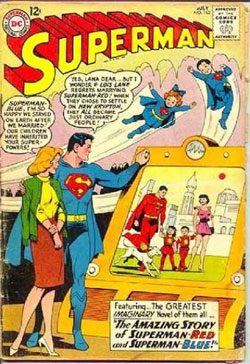 One of the most famous imaginary stories is "The Amazing Story of Superman-Red & Superman-Blue" from Superman #162 (1st series, 1963). Superman is divided into two colour-coded heroes that quickly solve all of Superman's problems, including restoring the bottle city of Kandor, finding an antidote to Green Kryptonite, eliminating crime and evil, and resolving the Superman, Clark, Lois, and Lana love quadrangle.
Sometimes these stories were presented as straight imaginary tales and were announced as such either on the cover or on the inside splash page. In other stories, Superman used a computer to create predictions -- as in "Superman's Other Life!" in Superman #132 (1st series, 1959). In that story, Batman and Robin decide to make a gift to Superman by feeding information into Superman's 'Super Univac' computer to predict what would have happened if Krypton had never exploded.
Most of the imaginary stories are light hearted and feature 'incredible coincidences'. "Superman's Other Life!" has these coincidences by the bucket. Superman goes to a masquerade party dressed as an Earthman ("By sheer chance, Kal-El made himself look like Clark Kent"). A professor accidentally gains super-powers to become the hero Futuro and makes Kal his sidekick, complete with an "ultrasonic signal-watch". Added to the coincidences are that Krypton's spaceman uniform is the Superman outfit and Lois Lane manages to stow away on a rocket that ends up on Krypton. While these plot elements would cause groans and even jeers if they were included in a modern story, the tale is a fun read.
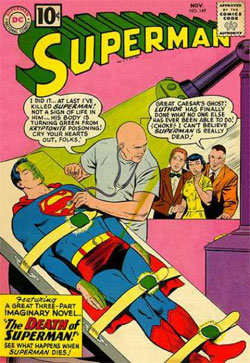 Not all of the stories were light hearted, as seen in "The Death of Superman" from Superman #149 (1st series, 1961). In this tale, Luthor creates a cure for cancer and convinces Superman that he has reformed. Readers expecting the usual happy ending to follow were undoubtedly surprised when Luthor captures and kills Superman. Superman's death by Kryptonite poisoning is slow and painful as Luthor gloats and Perry, Jimmy, and Lois watch helplessly. Mourners at his funeral include almost all of the supporting characters from the Superman mythos (such as the Legion, Krypto, Superman robots, Lori Lemaris, and the people of Kandor). Since we all know evil can never win in a comic book, Supergirl (who at the time had not revealed herself to the public) captures Luthor and continues Superman's never ending battle.
Anyone interested in these and other terrific pre-Crisis stories, can find them reprinted in the trade paperback, The Greatest Superman Stories Ever Told.
Notable Elseworld Stories
Following the Crisis On Infinite Earths maxi-series in 1986, DC continued to publish imaginary stories, calling them Elseworlds. Rather than have them in the regular comic titles, these were normally published as specials, often in the more expensive prestige format. Batman was the most popular Elseworlds character until the recent explosion of Superman-related Elseworlds stories. These stories were often darker than the Imaginary Novels, but continued the same trend.
There are many, many Elseworld stories - too many to mention in this article. These are some of my favourites.
Superman: Speeding Bullets is written by J.M. DeMatteis with stunning art by Eduardo Barreto. In this story, baby Kal-El's rocket is found by Thomas and Martha Wayne, who name the child Bruce and raise him until they are brutally murdered before the eyes of the young boy. As young Bruce's tear-filled eyes stare at the murderer, beams suddenly blast from those eyes, incinerating the killer. Bruce becomes a traumatized recluse, hiding his powers and abilities even from himself, until burglars break into Wayne Manor and the adult Bruce is forced to confront them and himself. Bruce becomes a super-powered Batman whose mask fully covers his face.
Without Superman to protect Metropolis, Luthor has taken it over. Perry White and Lois Lane have moved to Gotham City, where Bruce hires them for his paper, the Gotham Gazette. Luthor follows Lois to Gotham, and we learn that he has been horribly transformed by an accident in a chemical factory. In the end, Bruce Wayne is also transformed by Lois' love.
Another story with a similar theme is the prestige format Batman: In Darkest Knight, where Bruce Wayne is chosen to become a Green Lantern. Superman, Flash, and Wonder Woman have a small part in the ending, and the story (written by Mike Barr with art by Jerry Bingham) makes a nice companion piece to Superman: Speeding Bullets.
Superman: Kal (written by Dave Gibbons with art by Jose Luis Garcia-Lopez) has Kal's rocket landing in medieval England. Kal becomes a blacksmith, hiding his abilities at the urging of his father. He impulsively enters a tournament to impress the Lady Loisse, who is being held captive the Baron Luthor. Mighty Kal weakens when he meets Luthor, who wears a glowing green gem on a necklace. Luthor also discovers the rocket ship and has Kal work it into a suit of armour and a sword. Gibbons nicely mixes a tale of good versus evil and triumph alongside tragedy as the story builds toward a deadly, violent confrontation. Garcia-Lopez' art is well suited to the setting with lots of depth and detail.
There is also an unrelated Batman Elseworld that goes well with this story - Batman: Dark Knight of the Round Table, a two volume prestige series. While Superman doesn't feature in that story, it is well worth your money and could even be set in the same Elseworlds universe as Superman: Kal.
 Elseworlds stories took over the 1994 Annuals with several stories featuring Superman. My favorite was the two part story by Karl Kesel, "The Super Seven" in Adventures of Superman Annual #6 and Superboy Annual #1. The story takes place nine years after the invasion and defeat of Earth by the Malazza-Rem. The aliens turn the planet's population against its super-heroes by threatening to exterminate 5,000 humans whenever a meta-human opposed them. The heroic opposition fades after the slaughter of Coast City and the death of Lois Lane.
Lana Lang and Jimmy Olsen find Clark Kent and convince him to make one last attempt to defeat the aliens. They gather other heroes from the old Justice League and are joined by one other -- a youth calling himself Superboy. The super-heroes join the human resistance led by Lex Luthor as they plan the final assault against the alien conquerors. Kesel is able to write a big story with heroes trying to face up to their failures and fears and with several major characters dying. The story isn't all dark, however, as Kesel injects humour and hope in the two issues. There is a nice balance between characterization and action, with a particularly dramatic battle scene as the tale climaxes.
1997's two issue, prestige format Elseworlds' Finest by J.F. Moore has art by Kieron Dwyer and Hilary Barta. Set in 1928, it features an innocent Clark Kent (in Cary Grant mode) and a roguish Bruce Wayne (in Clark Gable mode) teaming up against Ra's Al Ghul and Alexei Luthor. During the story, Clark and Bruce go from ordinary to hero and from antagonism to best friends. Story and art complement each other to produce a great read, evoking the spirit of Raiders of the Lost Ark.
Superman: War of the Worlds honours the anniversary of Orson Welles' radio broadcast (based, of course, on H.G. Wells wonderful story) and Superman's debut, both from 1939. Roy Thomas weaves an interesting tale, combining the broadcast narration with scenes from Action Comics #1 and Superman #1 to open the book, and going on to create a unique story. The art by Michael Lark is good at evoking the period. I would have preferred a cleaner linework to make it more similar to Joe Shuster's art, although I can understand why Lark used a style which places more emphasis on the dark theme of the Martian invasion.
As a side note, Superman did meet Orson Welles once upon a time and helped him defeat the Martian Invasion. I'll review that story at the end of this article.
Superman's Metropolis was inspired by Fritz Lang's classic film, Metropolis. The artwork by Ted McKeever is unusual for a superhero comic. The story, by R.J.M. Lofficier and Roy Thomas, might have had more resonance for me had I seen the film. I was not impressed with the story on my first reading, but I found that the more I re-read it, the more I began to enjoy and appreciate both story and art. If you've seen Metropolis, or if you enjoy German cinema, you will probably like this story. This version of Superman is part of a trilogy paying homage to German films, which continues in Batman: Nosferatu, and concludes in Wonder Woman: The Blue Angel.
For a look at a Corporate Superman, enjoy 1999's Superman Inc., a one-shot written by Steve Vance. While a great tale about an orphan who's emergent super powers lead to the accidental death of his adopted mother. Suppressing knowledge of his powers, he becomes a famous basketball player and businessman, until his secret is revealed. While the story is an interesting and highly entertaining take on Superman, the real treat is the return of Jose Garcia-Lopez' pencils, inked by Mark Farmer.
Barbara Kesel honours the Superman legend in a modern setting in Elseworld's Finest: Supergirl & Batgirl. Kal-El's fate is an important element in this wonderfully written story, with eye catching art by Matt Haley and Tom Simmons. I can only hope this team will be given the opportunity to tell more stories about these characters.
There are JLA Elseworld stories that deal with Superman and his legend prominently. One of my favourites is the two issue, JLA: Age of Wonder, which sets Superman and colleagues in 1876 during the Age of Science. The story is by Adisakdi Tantimedh, with breakdowns by P. Craig Russell and lovely pencils/inks by Galen Showman. At the heart of the story is the Superman/Luthor conflict.
One of the most publicized JLA Elseworlds stories revolving around Superman are 1998's JLA: The Nail and the 2004 sequel, JLA: Another Nail (both in trade paperback). The first series primarily revolved around the absence of Superman as we see a world without his inspiration, and the effect of the nail which gave Jonathan and Martha Kent a flat tire, causing them to miss the rocket bringing the infant to Earth. The sequel has the new and inexperienced Superman finding his place among the JLA. The stories were written and pencilled by Alan Davis with inks by his long-time colleague Mark Farmer.
Also focussing on the same conflict is Mark Millar's triumphant Superman: Red Son which has the infant Kal-El's rocket landing in Russia and Superman raised as a Soviet hero, under the guidance of Stalin. The story was a long time coming due to art delays, but well worth the wait. The three issue series (collected in trade paperback) had Dave Johnson and Andrew Robinson illustrating the first issue, with the remainder by Kilian Plunkett and Walden Wong. While I enjoyed this unusual take on Superman, the kicker was the inspired ending, which tied the Superman and Luthor legacies in a way I'd never considered before and left me wondering why no-one had done this before.
With no Luthor in sight, Superman: Secret Identity (four issues, also in trade paperback) tells a story set on an Earth much like ours where a young Kansas boy named Clark Kent endures constant teasing about his comic book namesake. However, in his teens, he begins to develop powers just like Superman. This wonderful story by Kurt Busiek, with outstanding art by Stuart Immonen, had me smiling with enjoyment and waiting for the hammer to drop because it couldn't be this good without some tragedy waiting in the wings. I don't want to spoil the plot, but I will say that by the end of issue four, I was smiling even more than I had been when I started.
The Animated Superman
Superman also appears in animated version in the comic book, Superman Adventures, based on the television cartoon, Superman: The Animated Series. Before Superman got his own series though, he appeared in The Batman Adventures #25. The story, titled "Super Friends", has Bruce Wayne and Lex Luthor II bidding for a military contract, while Batman and the long-haired Superman stop a villain named Maxie Zeus. The story by Kelley Puckett is straightforward, and the art by Mike Parobeck and Rick Burchett is a wonderful example of the animated style.
When Superman got his own cartoon, it began with the 1997 special, Batman & Superman Adventures: World's Finest. The story has Superman and Batman discovering each other's identities and teaming up against the Joker and Luthor. Everyone is in early animated continuity, with the 'no chest oval' Batman, short-haired 'classic' Superman, and bald Luthor.
Superman & Orson Welles Defeat The Martians
Finally, as promised, the tale of Superman and Orson Welles defeating the Martian Invasion in "Black Magic On Mars!" The story is reprinted in the collection Superman: From the 30s to the 70s. The original issue is not identified, although the story has a 1949 copyright. The writer is not identified, but the artist is either Wayne Boring or someone imitating his style.
The famed actor unwittingly walks inside an unmanned rocket ship just before the director of the International Rocket Society launches it to Mars. (Don't you hate it when that happens?). Welles muses, "When I fooled the world with my Martian invasion broadcast, I never dreamed I would invade Mars myself!"
They built rockets real good in those days -- Welles lands on Mars two hours later. When Welles leaves the rocket, he is met by the Martians - dwarfish humanoids with big, flat-topped heads. Turns out these Martians have been observing Earth, learning to speak English and to admire Nazis (you'd think they would have preferred to speak German). Their leader, calling himself Martler (Martian Hitler -- get it?) is planning to blitzkrieg Earth.
Fortunately Welles is still in a swashbuckler's costume and is able to use his sword to capture Martler and to barricade himself in the Martian broadcasting studio. He broadcasts a warning to Superman and the people of Earth that the Martians are invading! No one on Earth will believe Welles, but fortunately Superman's telescopic vision tells him that this is a job for Superman. He bridges the astronomical distance between Earth and Mars at comet speed and saves Welles from the deadly blast of ray guns.
While Superman heads off to stop the Martian rocket fleet, Welles uses stage magic to defeat the villains. Welles uses smoke from a magic wand, and even a rabbit to drive fear into this cowardly and superstitious lot.
Oops, wrong hero.
Anyway, as Welles puts it, "Amazing! These Martians are far ahead of us scientifically, yet simple magic makes them react like superstitious savages!" Whew! Lucky for us Earthlings!
Meanwhile, Superman uses the rocket ship runway as a sling to send one of the Martian moons after the fleet. The fleet is trapped by gravity, becoming satellites of the moon, which Superman then tosses back into place. As the coup de grace, Superman uses the Martian television system, "Scan Mars," while Welles uses the unconscious Martler's body like a ventriloquist's dummy to announce that the invasion is off and everyone should go home. Fortunately, the typical Martian reaction is, "Great news ... I never did want to fight anyway!"
Ironically, when Clark Kent tries to write about his exclusive interview with Superman on the thwarted invasion, Perry White trashes the story saying, "This is a newspaper -- not a science-fiction magazine!" And, as the narration says, "the entire adventure has taken less than eight hours!"
And it was all told in just 12 pages!
Enjoy!